Kuala Lumpur • EST. 1897 • National heritage site
Bangunan Sultan Abdul Samad
The Soul of Kuala Lumpur
Over a century of colonial authority, independence, justice, and rebirth — all within one magnificent façade.
From Secretariat to National Symbol
Completed in 1897, Bangunan Sultan Abdul Samad was inaugurated on 3 April as the administrative headquarters of the Federated Malay States, marking Kuala Lumpur’s emergence as an organised civic and administrative centre. The building arose from Selangor’s rapid administrative growth under Sultan Abdul Samad, following the establishment of the State Council in 1877 and the shift of the capital from Klang to Kuala Lumpur in 1880. As the British administration outgrew its timber offices on Bluff Hill now known as Bukit Aman, Selangor State Engineer Charles Edwin Spooner proposed a new riverside site that offered better accessibility while anchoring governance at the confluence where the city first took root.
The project was led by Spooner, with design work by State Architect A.C. Norman and later refined by Chief Draughtsmen R.A.J. Bidwell and Arthur Benison Hubback. Midway through construction, Kuala Lumpur was designated the capital of the newly formed Federated Malay States, elevating the building into the administrative heart of the federation. Its architectural language, a synthesis of Mughal, Moorish and Gothic influences, was deliberately conceived to resonate with the Muslim Ruler of Selangor while projecting a sense of authority and permanence.
Upon completion, nine government departments moved in, including the Secretariat, Treasury, Survey Department and General Post Office. Over the next 130 years, the building served as a hub of governance, later housing Malaysia’s Supreme Court and standing as a backdrop to the nation’s independence journey. Renamed Bangunan Sultan Abdul Samad in 1974, it was gazetted as a National Heritage Site in 2007 under the National Heritage Act 2005, the highest designation of protection in Malaysia.
Six Key Interventions
Rather than recreating an idealised past, the 2025 programme set out to understand the building on its own terms. Guided by archival drawings, historical photographs, and physical evidence, concealed features were uncovered, documented, and — where possible — permanently reinstated.
Copper Dome & Finials
The three domes were fully rebuilt with a new two-layer system that prevents water damage while preserving their original historic appearance. At the peak, the copper finial was reconstructed based on original evidence, replacing an old timber substitute with a new copper-clad timber structure.
Parapet Finials Reinstated
Rather than recreating an idealised past, the 2025 programme set out to understand the building on its own terms. Guided by archival drawings, historical photographs, and physical evidence, concealed features were uncovered, documented, and — where possible — permanently reinstated.
The Rear Verandah
An electrical substation had blocked the rear colonnade for decades. With its removal, the full rhythmic sequence of arches was restored, reconnecting the building spatially as originally intended.
Façade & Brickwork
Cement mortar — applied in previous renovations — was meticulously removed by hand and replaced with lime-based plaster, allowing the original pink-toned PWD bricks to breathe once more.
Vaulted Ceilings
The building’s distinctive vaulted ceiling system, an engineering marvel of the 1890s, was stabilised and selectively exposed — allowing visitors to read the ingenuity of its original construction.
The Prisoners' Tunnel
Built in the 1980s and sealed for decades, the underground passage used to transfer detainees between courtrooms and holding cells has been reopened as a layer of the building’s judicial history.

"When the clock struck midnight on 31 August 1957, its chime marked not merely the passing of an hour, but a profound turning point in the nation's destiny."
Bangunan Sultan Abdul Samad — A National Heritage Icon
129 Years of Living History
From attap houses on the riverbank to a national cultural destination — trace the remarkable journey of Kuala Lumpur’s most enduring civic landmark.
Foundation Stone Laid
As part of the ceremony, Sir Charles Mitchell, Governor of the Straits Settlements, placed a yen, Straits coins, a piece of Selangor tin supplied by the Straits Trading Company, and a copy of that day’s issue of the Selangor Journal into a cavity beneath the stone on 6 October.
The Doors Open
On 3 April, the New Government Offices — later known as The Secretariat — are inaugurated by Sir Frank Swettenham. Nine federal departments move in from Bluff Hill.
The Clock Chimes for the First Time
A turret clock by the Croydon firm Gillett & Johnston is installed in June. Its first chimes ring out during Queen Victoria’s Diamond Jubilee celebrations.
Air-Raid Precautions
As World War II looms, parapet finials are removed and the domes are painted black to reduce visibility. King Edward VII’s bronze bust is taken into safekeeping.
The Clock is Silenced
On 8 December, the Japanese Imperial Army invades Malaya. An air raid strikes the BSAS clock tower — stopping the clock.
Malayan Flag Raised at the Secretariat
On 26 May, the Federation of Malaya flag was flown for the first time at the Secretariat’s porch, raised between the Union Jack and the Selangor State flag, marking a significant step towards independence.
Merdeka — Independence Declared
As the clock tower strikes midnight on 31 August, the Union Jack is lowered in silence. The Malayan flag rises; Tunku Abdul Rahman leads the cry of ‘Merdeka!’ seven times.
A New Name
As Kuala Lumpur becomes a Federal Territory, The Secretariat is formally renamed Bangunan Sultan Abdul Samad — in honour of the Sultan who reigned during its construction.
First Heritage Listing
Bangunan Sultan Abdul Samad is gazetted for preservation under the Antiquities Act 1976 — Malaysia’s earliest formal recognition of the building’s significance.
Judiciary Era Begins
Following major renovations, Bangunan Sultan Abdul Samad reopened on 26 March as Malaysia’s Supreme Court, officiated by the Yang di-Pertuan Agong, DYMM Sultan Ahmad Shah. Upgrades included an underground passage for detainee transfer, new mezzanine floors, and a sub-basement car park, reflecting its transition into a dedicated judicial complex.
Dataran Merdeka is Born
The Padang is remodelled into Dataran Merdeka, and a 102-metre flagpole is erected. The building becomes the unmistakable backdrop of the nation’s most iconic civic space.
Courts Relocated
Malaysia’s superior courts relocated to the Palace of Justice in Putrajaya, marking the end of Bangunan Sultan Abdul Samad’s role as the nation’s judicial centre.
National Heritage Gazetted
On 6 July, the building is formally gazetted as a National Heritage Site under the National Heritage Act 2005 — the highest designation of protection in Malaysia.
Return to Government Administration
Following the courts’ relocation, the building was repurposed to house government offices, including the Ministry of Tourism and Culture and the National Heritage Department, restoring its role as a working administrative complex while reinforcing its heritage significance.
Public Realm Transformation
As part of the River of Life project, the former sub-basement car park was removed to make way for a sunken garden with fountains and landscaped elements. Jalan Mahkamah Persekutuan was also pedestrianised, enhancing the building’s civic presence and public accessibility.
Khazanah's Dana Warisan
Khazanah Nasional is entrusted to establish Dana Warisan, a vehicle for the revitalisation of eight significant Malaysian heritage buildings, with BSAS at its centre.
Conservation & Reopening
An 11-month conservation programme — guided by archival drawings and historical evidence — restores the building’s architectural rhythm as a landmark civic and cultural destination.
A Building Designed to Last Forever
From foundation to finial, every decision in the construction of Bangunan Sultan Abdul Samad was made with permanence in mind. Built entirely of locally produced materials, a first for a major government complex in the region, it was also among the earliest buildings in the city to be electrified.
Copper Dome & Finials
A confident synthesis of Mughal, Moorish, and Gothic influences, the building’s arches, domes, and brickwork were the deliberate language of an empire seeking to govern in dialogue with its Malay sultanate. Recommended by C.E. Spooner to resonate with the Muslim Ruler of Selangor.
Four Million Local Bricks
Construction relied entirely on locally fired clay bricks, produced at a government factory in Brickfields (present-day NU Sentral) established specifically for this building. Their natural pinkish tone, long hidden beneath cement, now defines the façade once more.
Built for the Tropics
Base walls approximately 2.5 feet thick, deep verandahs, horseshoe arches, and a lime-mortar construction system allowed the building to breathe, shed moisture, and perform in Kuala Lumpur’s equatorial climate, a standard of environmental thinking ahead of its era.
Kuala Lumpur’s Historic Timekeeper
The 41.2-metre clock tower, the tallest structure in KL upon completion, houses a Gillett & Johnston mechanical clock from 1897. Wound by hand, its four faces measuring over 2.4 metres in diameter, it continues to be maintained by trained officers to this day.
A Living Heritage Icon
Rather than recreating an idealised past, the 2025 programme set out to understand the building on its own terms. Guided by archival drawings, historical photographs, and physical evidence, concealed features were uncovered, documented, and — where possible — permanently reinstated.
Tourism Malaysia
A Travel Information Counter providing visitor assistance, heritage wayfinding, and orientation across the Dataran Merdeka precinct.
Royal Selangor Gallery
Linking heritage pewter-making with contemporary practice through exhibitions, hands-on learning, and public art.
KL City Gallery
Immersive exhibitions tracing Kuala Lumpur’s development from the 1820s to the present across six distinctive curated halls.
Events & Dining
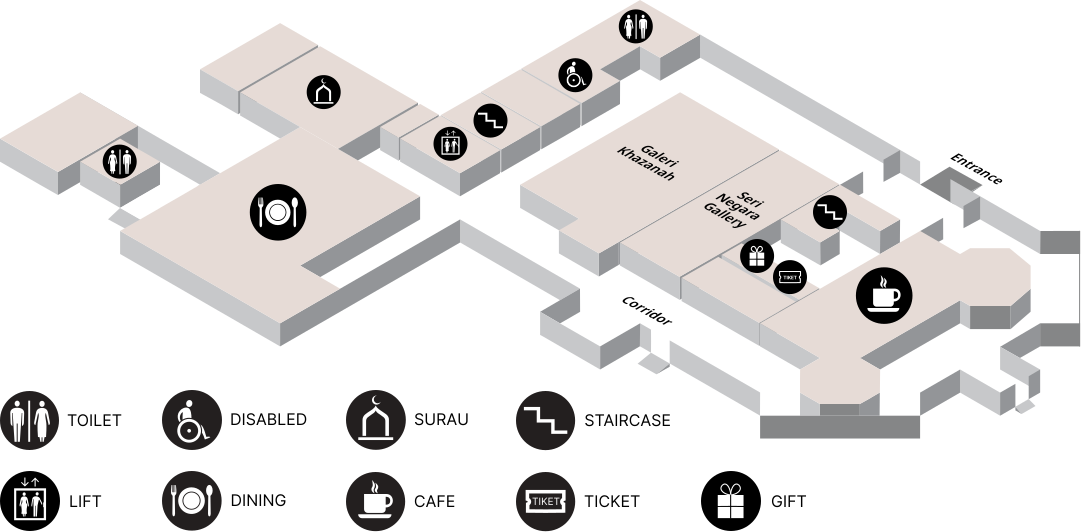
Malaysian flavours reinterpreted within a historic setting, alongside flexible halls for exhibitions, talks, and cultural programmes.